Creating A Sustainable, New Paradigm Economy
Based on the experience of the unprecedented success of members of the SHIPP™ Team in building affordable housing, and community, and reducing crime in low income neighborhoods in the United States; and bringing social capitalism to Eastern Europe after the fall of the Soviet Union, we can monetize assets to create abundance and coordinate social, community and business development.
Because of our panelized construction system, we can build affordable housing for much less cost, but inexpensive housing only solves a part of the problem. Our proven social model resolves the other parts, producing empowerment, so that the affordable housing we have managed has less crime and greater resident functionality and satisfaction.
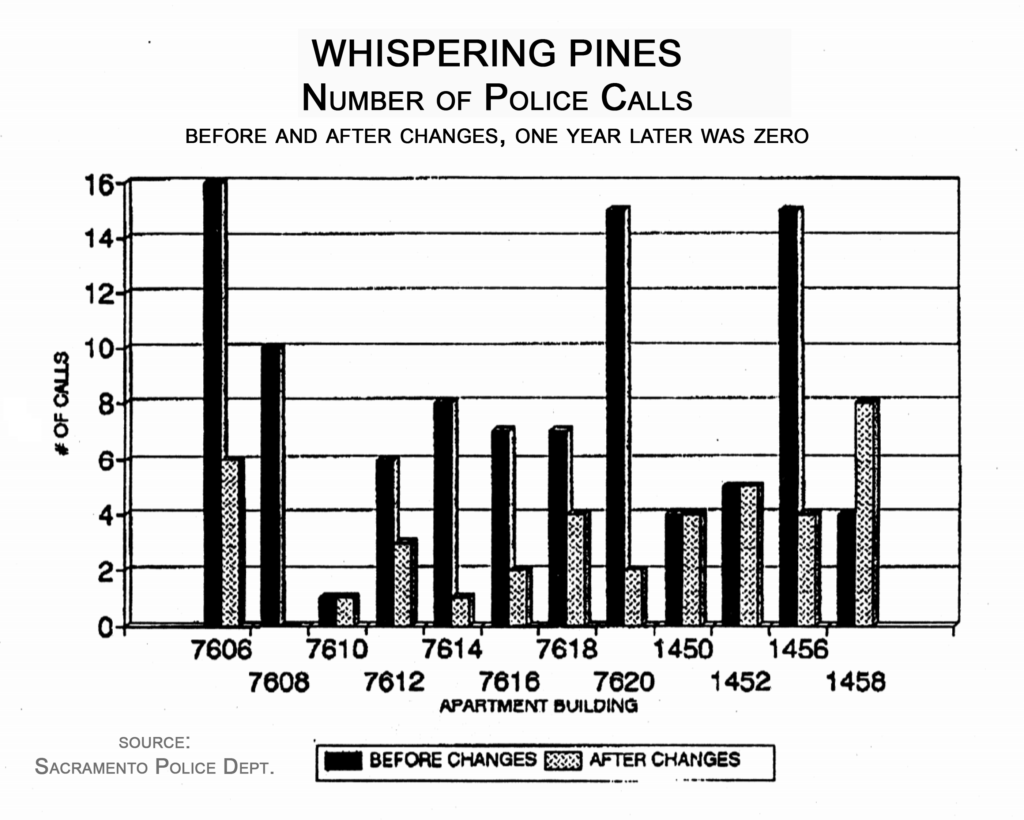
Our approaches were first instigated at a low-income housing project in Sacramento, California. It started in 1990, with renovation of the facility, with rudimentary social programs, producing a reduction in police calls of 80%. Then we added a Family Center with after-school programs for 3 age groups of kids, a full range of social programs, a community gardens, and brought in a Head Start program, with police calls dropping from 435 per year to zero for the entire year the next year.
The success of our approach is documented with graphs made by the Police Department of the City of Sacramento, California (see below and the “References and Resources” link shown in red, below).
We also submit that Group Rapid Transit, which can involve a hybrid system with is America’s Answer to High-Speed Rail, can become the foundation for revitalization, because housing and transit are inexorably linked.
We can state with assurance that:
-
Marginalized people become healthier, better socialized, and less prone to being victimized, or to perpetrate crime.
-
Homelessness can be dramatically reduced, with a corresponding decrease in calls for emergency services.
-
Drug use, and the costs of services, policing, courts, jails, are reduced, and other associated results. The psychology of teamwork and abundance for all can multiply as the results are compounded (with costs reduced for,
We have had quantifiable success in reducing crime calls from 435/year to 0 (zero) for the entire year in an affordable housing community with hundreds of people by a combination of physical improvements and social programs that included cultural celebrations that then allowed a transit station to be installed in a previously problematic area of Sacramento, California. That area was previously too dangerous to consider such or similar infrastructure development. (See the link below)
The social programs will be similar, but on a much larger scale in Oakland, California, than previously in Sacramento, as will the paradigm-changing physical improvements that we propose to provide- in the form of affordable housing for program participants (with many subsidized by the USDA), and a lower-cost transit solution, because:
- Part of the economic engine that we can create involves monetizing real property assets of cities that can include Oakland and nearby Alameda by building a cost-effective transit system and Transit-Oriented Development in exchange for acquiring the land and entitlements on which transit and transit-oriented development can be built. (In Oakland, the Port of Oakland owns most of the dozens of miles of waterfront, with a similar situation in the nearby City of Alameda.
- Another part is the use of federal funds in the form of housing subsidies (from the Veteran’s Administration and U.S.D.A. – because of the agricultural component to the program) and transit subsidies.
- Another part is to create a Benefit Assessment District, and for it to sell bonds.
Installing a transit system has substantially always increased the value of the real estate to a greater degree than the cost of the transit system- with the Transcontinental Railroad being a prime example. However, the positive impact is even greater where the cost of the system